
You’ve found products that sell. The inventory is there, the margins work, the photos are decent. The part nobody films is what comes next: getting each listing in front of buyers across a dozen local groups. That means learning to post at volume without Facebook deciding you’re a bot and quietly turning off the taps.
Do it by hand and it eats the day. Do it carelessly and you risk the account you spent months building: the one with the followers, the sales history, the trust people extend to a seller who has been around.
There is a middle path between grinding it out manually and scripting it and praying. It is seven habits. None of them need software, and none of them cost anything. They are also, not coincidentally, exactly what any tool is trying to automate, so getting them right first is what keeps you safe whether or not you ever buy one.
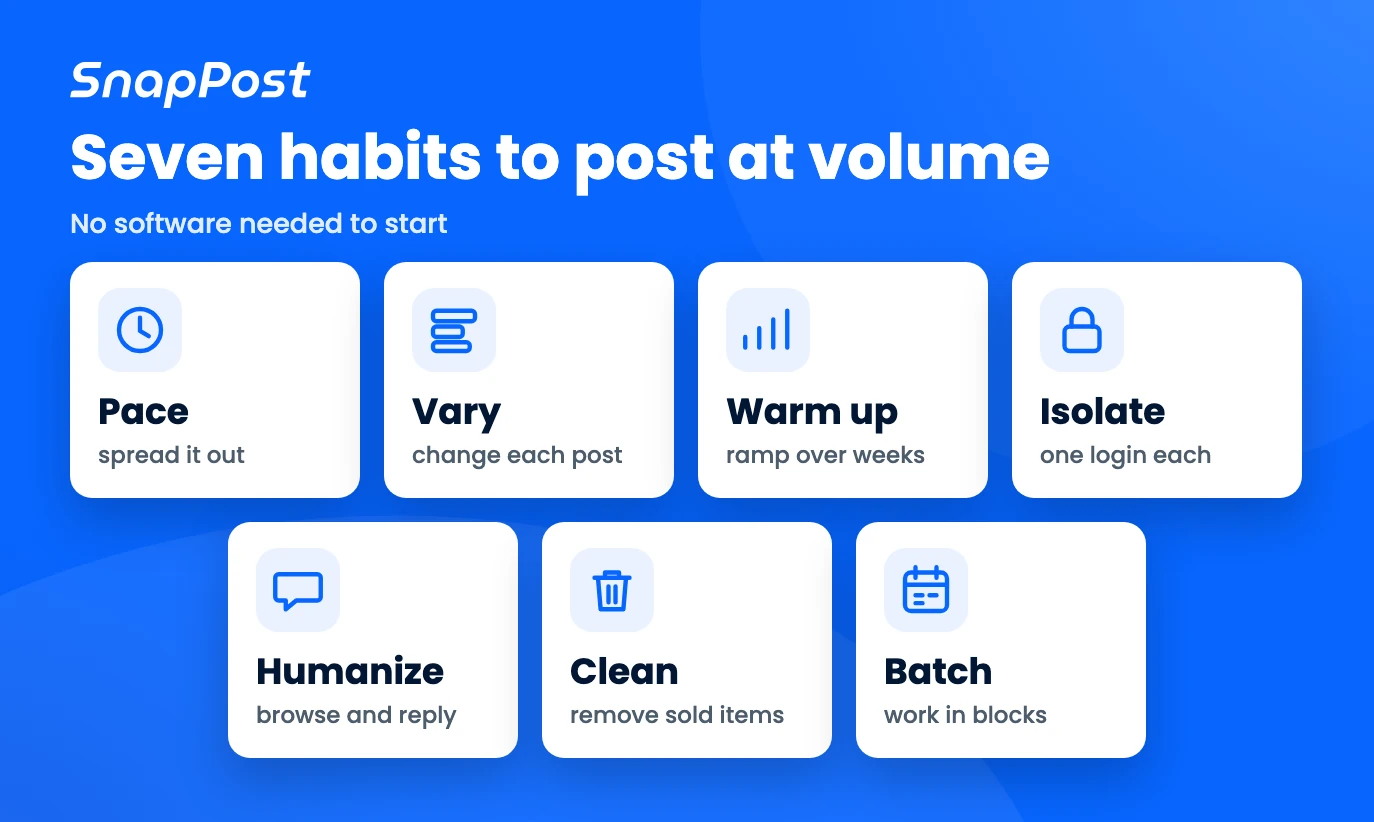
Post at volume: the seven habits
- Pace: spread joins and posts across hours and days; no bursts.
- Vary: change the opening line, lead image, and emphasis for each group.
- Warm up: ramp a new account gradually over a few weeks before pushing volume.
- Isolate: give each account its own consistent login context and browser profile.
- Humanize: browse, reply, react, and leave real gaps between actions.
- Clean: expire or remove sold and expired listings on a fixed schedule.
- Batch: write, share, and clean up in a few fixed blocks each week.
Spread the work across the day
Thirty groups in four minutes is the pattern sellers warn each other about. Not because thirty is too many. Because four minutes is not how a person works.
Nobody outside Meta knows the real thresholds, and any article that quotes you a number is guessing. What sellers agree on is the shape of the problem: activity that arrives in one spike looks like a script. Meta’s Help Center names one cause of a temporary block: “Posted a lot in a short amount of time” (Meta Help Center). Group admins can add limits of their own: Meta says an admin may have “temporarily limited how frequently you can post or comment” (Meta Help Center).
So give the day a shape instead. Three posts over morning coffee. Three after lunch. Three in the evening with the TV on. Nine posts, the same nine you were going to make anyway, spread across the hours a person is awake and holding a phone.
New groups get the same treatment: three to five a day rather than fifty in one sitting. That number is our own conservative pacing, not a limit Facebook publishes, and the later numbers in this article are ours too.
What you’re aiming for is an activity graph that looks like nothing at all. Boring is safe. If your posts are already vanishing, start with why group posts disappear.
What "vary it" actually means
Most sellers hear “vary your posts” and change three words. Here is the difference between changing words and changing a post.
One couch, ten groups, in the form that gets matched:
Sectional couch for sale. Grey, good condition. $450. Message me.
The same couch, three groups, three posts:
Grey sectional, fits a small living room — $450, pickup this weekend in Tempe.
Moving sale: sectional, no pet hair, no smoke. $450 firm, and it’s clean.
$450 sectional. I can hold it until Sunday if you need to borrow a truck.
Nothing about the couch changed. What changed is what each post leads with: the room it fits, the thing a buyer quietly worries about, the favour that closes the deal. The third one isn’t even really about the couch. It’s about the pickup, which is the actual reason people back out.
Do the same with the photos. Swap which image leads and reorder the rest, so the thumbnail a scroller sees in one group isn’t the thumbnail they saw in another. Meta has open-sourced PDQ, an image hash that “tries to match images which people perceive as similar” (PDQ README). Meta has not said whether anything like it looks at group posts, so treat it as a reason to change the picture, not as proof.
This is the habit people skip because it feels like busywork, and it is the one that most separates a person selling a thing from a script pasting a thing. Keep a bank of six openings and three lead photos per item. Then the variation costs a minute, not a fresh writing session every time.
The first two weeks
A brand-new account that mass-posts on day one has nothing behind it. No history, no habits, nothing that reads as a person.
So spend two weeks being a person. Three to five posts a day at most, with long gaps. Browse between them. Answer a comment. Leave the thing alone for an afternoon. Then step up a little at a time, and only while nothing has gone wrong.
One flagged account can sink the rest
Suppose Facebook can link your accounts to one operator: same IP, same browser fingerprint, the same actions in the same order. Then a check on one could become a risk to all of them. Sellers describe losing several accounts at once this way: one trips something and the siblings go down beside it.
Keep each account in its own consistent login context. Same device, same browser profile, same routine, every single time, and different from every other account you run.
Consistency within an account. Separation between accounts. An account that changes its fingerprint every week looks evasive; ten accounts sharing one fingerprint look like one person with ten logins. You want neither.
Posting-only accounts stand out
An account that posts, posts, posts and does nothing else is a pipe. Nobody outside Meta can say what it watches besides what you publish, so assume it can see more than that and give it something a person would do between publishing.
| A posting machine does | A seller does |
|---|---|
| publishes, logs off | publishes, then reads the group for a minute |
| ignores comments | answers “is this still available?” |
| acts every 40 seconds | disappears for three hours to eat dinner |
Add the other half. Browse. React to something. Reply to the comment even when the answer is no. Leave the real gaps that come from putting the phone down to answer the door.
A tidy shop beats a full one
Expired and sold listings pile up faster than anyone expects, and a storefront of ghosts costs you twice. Buyers scroll past a shop where half the items are already gone, and the listings that are still live sit among them looking just as stale.
Pick a day and clear them. Friday morning, ten minutes, everything sold or expired comes down. The front page should only ever show what somebody can actually buy today. A listing that is stale rather than sold may only need Facebook’s own Renew option first; our guide to relisting Marketplace items covers it.
Staying sustainable as volume grows
Don’t list one at a time all day. That’s how a hundred listings eat eight hours and leave you too fried to do the distribution that actually matters.
Do ten to twenty in one sitting, from a template you reuse. Write in a block, share in a block, clean up in a block. Focus lasts longer in a sprint than in a slow drip, and a template turns each listing into minutes instead of an hour.
Batching is also what makes the other six habits survive a busy week. Pacing and variation are easy on a Tuesday with four listings. They’re what gets dropped first on the Thursday you have forty — unless the work already lives in blocks.
FAQ
How many groups can I safely post to in a day?
There’s no published number, and anyone quoting one is guessing. Distribution matters more than the total: nine posts across three sittings reads very differently from nine posts in four minutes, even though the count is identical. Start lower than feels necessary and let the account earn its volume.
What actually makes an account look like a bot?
Sameness and speed. Identical copy and an identical lead photo across many groups, actions at machine-regular intervals, and nothing in between the posting. Accounts that also read, react and reply are doing the thing a script doesn’t bother to do.
Do I need software to post at volume safely?
No. All seven habits work with zero tools. They’re discipline, not features. Software matters when doing them by hand stops being realistic, usually somewhere past a few accounts and a few dozen listings a week.
How do I stop one flagged account taking down the rest?
Isolate them. Each account gets its own consistent device and browser profile, and none of them run in lockstep with the others. The goal is that nothing links them to one operator — not the fingerprint, not the timing, not the identical wording of the posts.
If you’ve outgrown doing this by hand, a native desktop app like SnapPost covers three of the seven habits: it randomizes posting times (pace), isolates each account’s browser fingerprint (isolate) and simulates human behavior (humanize), across Facebook Groups and Marketplace. Varying your posts and batching your week stay with you, and clearing out old listings is an optional paid add-on. (Full disclosure: SnapPost is our product.) The checklist is the foundation either way. Get those seven right first and the software is doing something useful rather than doing it faster and louder.